Since 2010 • Rajajinagar, Bengaluru

The Art & Science of
Handcrafting FRP

Every planter we create carries the precision of skilled artisans and the performance demanded by India's most discerning architectural projects.
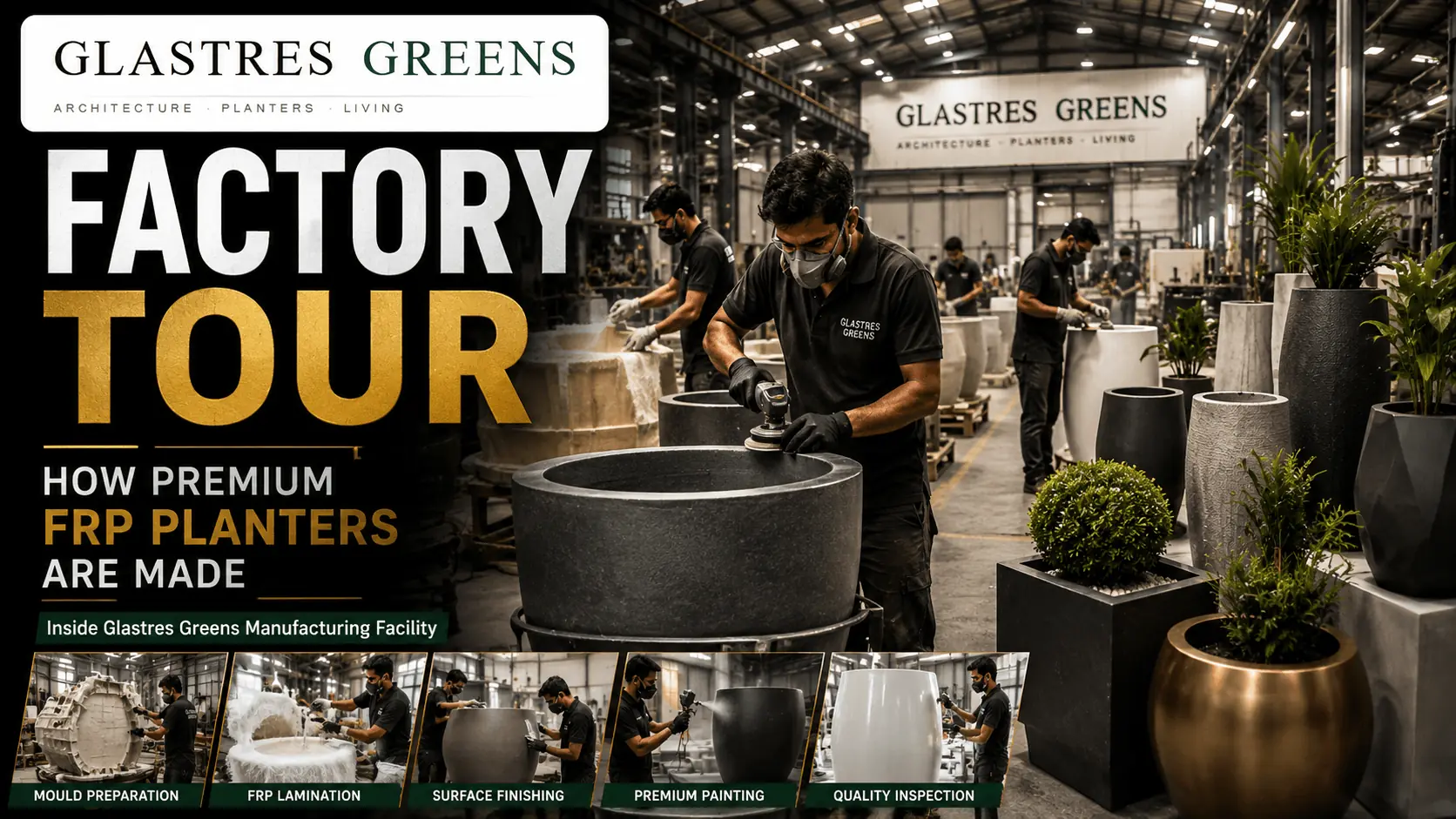
Precision manufacturing of premium FRP planters
Artisanal
Hand-Laid Fabrication
Our Manifesto

Deliberate
Craftsmanship

At Glastres Greens, we have deliberately chosen an artisanal, hand-laid manufacturing process over automated production. This ensures consistent wall thickness, void-free lamination, and the ability to deliver truly custom architectural pieces that machine-made planters simply cannot match.

Manufacturing Protocol

The 7-Stage Process

01.

Mold Design & Prep

Every design begins with precision engineering. We create molds that capture the finest details—from subtle ribbing to dramatic stone finishes. Molds are meticulously treated with release agents to ensure flawless demolding.

Critical for Custom Commissions
02.

Gelcoat Application

A high-performance, UV-stabilized isophthalic gelcoat is applied as the first layer. This becomes the primary barrier against India's harsh UV radiation, available in matte, satin, and high-gloss finishes.

03-04.

Multi-Layer Hand Lamination

The heart of our process. Skilled artisans hand-lay multiple layers of premium chopped strand mat and woven roving with high-grade resin. Each layer is saturated and rolled to eliminate air entrapment. Wall thickness is built to exact engineering specifications (6-12mm).

Result: Monolithic Composite Structure
05.

Controlled Curing

Proper curing is essential for performance. Our climate-controlled area ensures optimal cross-linking of the resin matrix. This directly contributes to the 20+ year lifespan and resistance to environmental degradation.

06.

Demolding & Hand Finishing

After curing, planters are carefully demolded. Our finishing team hand-sands, textures, and inspects every surface to perfect the distinctive character of each finish—whether rugged stone, wood grain, or smooth concrete.

07.

Rigorous Quality Inspection

Every planter undergoes multi-stage checks: visual inspection, dimensional accuracy, surface finish quality, and structural testing. Only flawless pieces are approved for dispatch.

Zero Compromise on Quality
Material Engineering

The Science Behind the Craft

Beyond the aesthetics of handcrafting lies strict adherence to composite material science, ensuring our planters perform under immense structural loads.

Resin-to-Glass Ratio

Automated spray-up methods often result in resin-rich, brittle structures. Our hand-lamination guarantees an optimal fiber-to-resin ratio, maximizing tensile strength while keeping the profile lightweight.

Woven Roving Integration

For oversized containers, we interleave chopped strand mat (CSM) with biaxial woven roving. This cross-directional reinforcement prevents outward bowing when filled with saturated soil.

Polymer Cross-Linking

We utilize high-grade Isophthalic gelcoats which feature a denser molecular cross-link structure than standard orthophthalic resins, providing vastly superior resistance to water osmosis and UV chalking.

The Artisanal Difference

Why We Choose Handcrafting

Superior Structural Integrity

Hand lamination allows us to build consistent thickness and eliminate voids that occur in automated spray-up processes. The result is a stronger, shatter-resistant planter.

Unmatched Customization

We can produce truly bespoke shapes, sizes, and textures economically — a flexibility that rigid mass-production lines struggle to provide for unique architectural projects.

Attention to Detail

Every planter receives the personal attention of our skilled artisans. This human touch is visible in the final finish quality that our high-end clientele has come to expect.

Experience the
Craftsmanship.

Interested in visiting our Bengaluru studio or discussing a custom manufacturing project? Let us bring your architectural vision to life.

Hand-Laid Matrix
7-Stage Protocol
Zero Automation
Master Crafters